Somatic Therapy San Francisco: Why Talk Therapy Isn’t Enough For Anxiety (and What Works Better).
Why Talk Therapy Doesn’t Always Work for Anxiety
You know the feeling. . .your heart racing and your panicked thoughts overtake logic in a circular loop. The same thoughts come up over and over again and even if you tell yourself “calm down” your brain and certainly your body doesn’t seem to comply. Perhaps you have even done talk therapy but found that speaking continually about your problems but felt like nothing got resolved. Although I am a somatic therapist and wholly believe in therapy, therapy has not always worked for me. In particular, talk therapy did not manage my anxiety.
The kind of therapy that I participated in allowed me to ruminate, rehash, and understand my anxiety from an intellectual point of view never significantly shifted how I felt in my body. For me anxiety was such physically intense experience. It felt like I needed to take action, any action, to the point where I felt like bursting out of my own skin. Talk therapy would provide relief briefly but never seemed to address those sensations.
The sensations and anxiety’s effects on the body are often missed in traditional talk therapy. Anxiety is not a problem to be addressed by thinking: it’s a nervous system problem.
Anxiety Lives in the Body—Not Just the Mind
Most traditional talk therapy focuses on thoughts, beliefs, cognitive patterns, and past experiences. And while this can be incredibly helpful for insight, it often overlooks something essential:
Your body is still reacting as if you’re not safe.
You might intellectually know you’re okay.
But your heart is racing.
Your chest is tight.
Your stomach is in knots.
This is because anxiety is rooted in the autonomic nervous system: specifically the fight, flight, freeze, or fawn response.
You cannot think your way out of a nervous system state. In fact, thinking logically is actually difficult and near impossible when the sympathetic nervous system is activated.
The Missing Piece: Nervous System Regulation
If you’ve ever said:
“I understand why I feel this way, but I still feel anxious”
“I’ve talked about this so many times, but I can’t seem to change how I feel”
“Why does this keep coming up? I thought I was over this?”
You’re not alone and there is a way to heal. What’s often missing is bottom-up healing—working with the body, not just the mind. This is where somatic therapy comes in.
What Is Somatic Therapy?
Somatic therapy is any body-based approach to psychological healing that focuses on:
Physical sensations
Movement
Breath
Nervous system regulation
Instead of a therapist asking, “What are you thinking?” A somatic therapist asks, “What are you feeling in your body right now?”
This subtle shift changes everything and is where the work of any somatic therapy starts.
Why Somatic Therapy Works for Anxiety
Somatic therapy helps you:
1. Complete Stress Responses
Anxiety often comes from unfinished survival responses in the body where your system is stuck in activation.
Through somatic work, your body can finally release tension and return to safety.
2. Build Capacity for Emotions
Instead of avoiding or overanalyzing feelings, you learn to:
Stay present with sensation with the help of a therapist
Expand your tolerance of discomfort
Feel without becoming overwhelmed
3. Create Lasting Change (Not Just Insight)
Building insight is helpful but it doesn’t always create transformation.
Somatic therapy works at the level where anxiety actually lives in the body.
This is why many people experience:
A reduction in baseline anxiety level
Less reactivity to psychological triggers
A greater sense of grounding and calm
Talk Therapy vs. Somatic Therapy
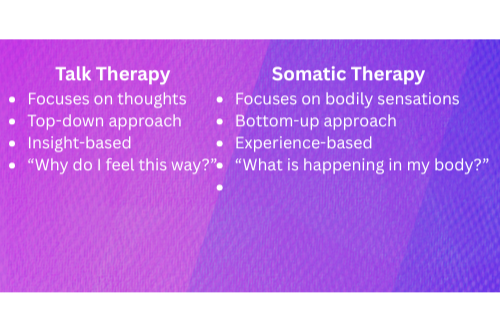
Both are valuable—but for anxiety, the body must be included.
When Talk Therapy Is Helpful
To be clear, talk therapy is not “bad” or ineffective. In fact, itIt can be incredibly supportive for:
Processing life events
Understanding patterns
Building self-awareness
Feeling heard and validated
But if anxiety persists after trying talk therapy for a period of time, it may be time to add a somatic approach.
Signs You Might Need a Body-Based Approach
You may benefit from somatic therapy if:
You feel stuck in a cycle of anxiety despite years of therapy
You overthink but still feel overwhelmed and stressed
Your body feels tense, restless, or shut down and no amount of talking relieves that
You struggle to relax, even when things are “fine” or maybe especially when things feel “fine”
You experience dissociation, panic, or chronic stress
Somatic Therapy in San Francisco
If you’re looking for somatic therapy in San Francisco, you are in good company. Many high-achieving, self-aware and very motivated individuals find that:
Examining their thoughts through talk therapy alone isn’t enough—they need a way to feel different, not just think differently.
Somatic therapy offers a path toward:
Finding safety in your body
Embodying emotional resilience
Regulating your nervous system
Lastly, if talk therapy hasn’t worked for your anxiety, it doesn’t mean you’re doing something wrong. It may simply mean that you need a different approach to psychological healing. Since healing doesn’t happen through words alone, you may benefit from including the body via a somatic therapy. When you can finally embody safety and truly feel safe, everything in your life will change.
FAQs
Is somatic therapy better than talk therapy?
Not necessarily better—just different. Many people benefit from a combination of both and a client can see both a talk therapist and somatic therapist at the same time. Or, if a client feels stuck with talk therapy, they may benefit from taking a break and working with a somatic therapist for a period of time and resume talk therapy later.
How quickly does somatic therapy work?
Some people notice shifts quickly, especially in how their body feels. Long-term change happens with consistency and it is recommended to try a minimum of 10 therapy sessions to provide long-lasting change.
Can somatic therapy help with panic attacks?
Yes. It’s especially effective for panic because it directly addresses nervous system activation. You can learn how to help your body feel safe.
Last Thoughts
If somatic therapy in San Francisco sounds like the right fit for you, please reach out to me at lisa@lisamanca.com. I would be happy to answer any questions or help you find a somatic therapist.